| |

|
|
|
|
|
|
|
|
|
|
|
|
Hello Power Up readers! The world is watching as Europe struggles with its gas crisis and the world’s major industrial economies grapple with trying to limit Russia’s oil revenue. We’re also looking at Chinese demand, Nigerian output, and U.S. solar - so let’s dive in.
|
|
|
|
|
|

|
|
|
|
Oil product tankers near the port city of Nakhodka, Russia, August 12, 2022.
|
|
|
The biggest world economies known as the G7 are trying to fine-tune a method of capping Russia’s revenue from its oil sales. If enough nations sign up and the United States cuts off enough of world trading infrastructure (such as insurance for shipping), the plan is to set a limit for what buyers can pay Russia for its oil - keeping oil flowing but reducing its oil export revenue.
Would that work? Moscow has threatened to cut off anyone who signs up, but Russia needs the oil revenue. It has maintained crude exports largely through cheaper sales to India and China, which aren’t likely to join the G7 effort. “Both India and China understand that Russia can react differently than what the United States expects them to do,” Natasha Kaneva, global head of commodities at JP Morgan, told me.
However, India and China could always use that cap as leverage to demand lower prices. That appears to be what the U.S. Treasury is hoping for - a Treasury spokesperson on Sunday noted Russia is offering even steeper discounts to India, saying it shows the cap is increasing “the leverage of oil purchasers negotiating with Russia, even if they don’t formally join the coalition.”
One other effect: the bans on global shippers, piloting, and insurance for Russian oil would limit Moscow’s ability to send oil worldwide. JPM’s Kaneva said Russia, India and China’s combined tanker capacity is only 3.2 million barrels per day (bpd) - putting about 900,000 bpd of daily shipments at risk; she assumes Moscow will have to cut output by about 600,000 bpd beginning in December.
|
|
|
|
|
|
|

|
|
|
|
Graphic by Muyu Xu
|
|
|
Oil demand in China might contract for the first time in two decades this year - and China is the market’s lodestar for the pace of overall global demand. That’s evident in crude oil trading, where the impetus more often than not lately has been to sell despite real supply-related concerns and threats from OPEC to cut output.
Energy Aspects thinks China’s fuel demand could be down by 380,000 bpd this year, Muyu Xu reports. The numbers already out there aren’t strong - crude imports fell in the first half of 2022 for the first time since 2004. Independent refiners have been running at lower rates than usual due to tax probes, manufacturers are running at lower-than-usual rates, and the nation’s hardline zero-COVID policy means people are subject to being locked down at a moment’s notice.
Demand could turn on what happens between now and mid-October amid the Mid-Autumn festival and Golden Week; several cities have already said they expect traffic to be down anywhere from 20% to 50%. Bookings for domestic air travel during the holiday are down 38.5% from 2021, per ForwardKeys, while flight bookings for Golden Week travel are expected to fall by 24% from last year. Travelers are fearful of getting stuck due to sudden outbreaks of COVID, for starters.
Why does this matter so much? China consumes about 15 million bpd of crude, and imports more than anyone else - at more than 10 million bpd.
|
|
|
|
|
|
|

|
|
|
|
Ukraine's President Volodymyr Zelenskiy welcomes Norway's Prime Minister Jonas Gahr Stoere to Kyiv in July. Handout via Ukrainian Presidential Press Service.
|
|
|
As winter approaches and Europe pulls together a series of emergency proposals, member nations are divided over whether to cap high gas prices, - or even how it would work. For the record, the Dutch natural gas benchmark is at about $57.41 per million British thermal units, off the surge above $90 in August - but still way above the $7.91 level for U.S. gas.
Even though Russia’s Nord Stream 1 pipeline isn’t coming back, the market has been falling due to “uncertainty among market participants on the potential impacts of possible EU market interventions, in addition to very healthy storage levels across Europe,” notes Rystad Senior Analyst Fabian Ronningen.
Ministers on Friday asked Brussels to propose a cap, but countries disagree on whether a gas price cap would ease or exacerbate Europe's energy crisis. There’s also confusion over what form it should take, be it a price cap on all imported gas, pipeline flows, wholesale gas trading, or supplies from Russia. Some countries think a cap on Russian gas would cause Moscow to cut off supply outright; others think a broader cap would just make it harder for Europe to source supply.
Notably, Norwegian Prime Minister Jonas Gahr Stoere has thrown cold water on the idea, saying that a “maximum price would not solve the fundamental problem, which is that there is too little gas in Europe." Norway is not an EU member, and is also a big gas exporter to the EU.
|
|
|
|
|
|
|

|
|
|
|
Graphic by Libby George
|
|
|
The largest producer in Africa, Nigeria, has seen its crude production drop below 1 million bpd in August - that’s its worst in decades, and the result of lack of investment and pipeline theft.
Many nations have been able to fill their coffers as a result of the surge in prices in 2022 following Moscow’s invasion of Ukraine - but Nigeria hasn’t.
The country’s output is down, and it has been subsidizing domestic gasoline prices for years, making it even harder to deliver higher revenues and funnel those funds back into the likes of investment, figures from its regulator show, as the nation grappled with rampant theft from its pipelines and years of underinvestment.
Nigeria fell behind Angola as Africa's largest exporter in July, according to OPEC figures. Both countries are also dealing with years of low investment that have hurt production.
|
|
|
|
|
|
|
|
|
|
|
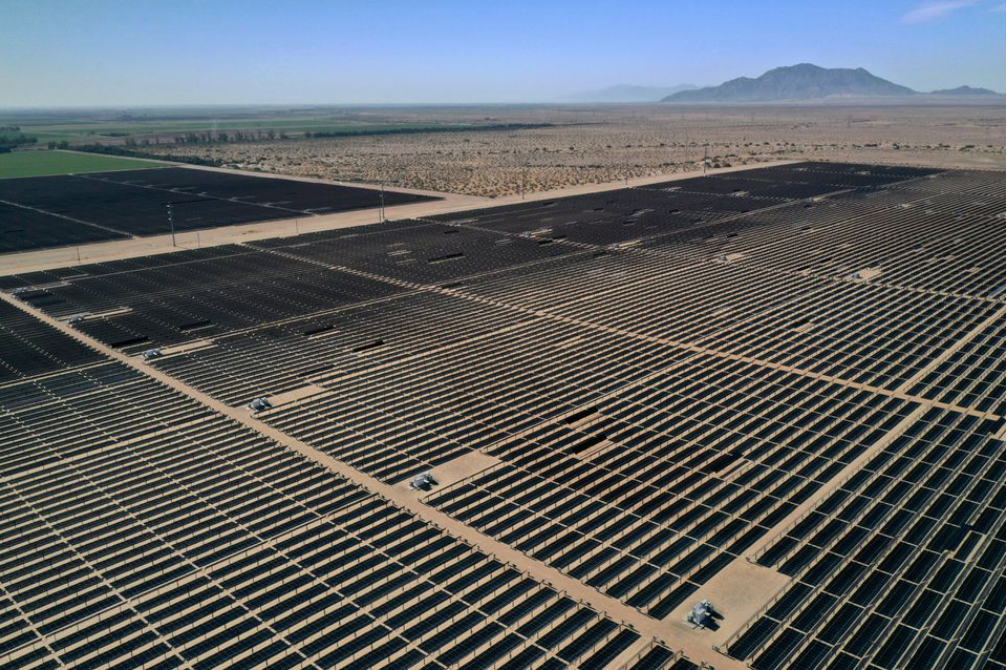
Solar panels! As far as the eye can see!
|
|
|
The Inflation Reduction Act has already spurred a flurry of announcements of new production facilities geared at ramping up solar manufacturing, carbon capture and other projects, all of which experts say is needed if the United States is to reach goals for lowering overall emissions.
Not every plan may come to fruition, but when it comes to modular solar panel production, total announced facilities would produce as much as 30 gigawatts of planned manufacturing capability, according to Chris Seiple, vice chairman of the power and renewables team at Wood Mackenzie.
The United States right now only uses about 24 GW of solar per day, so that’s a big jump - but Seiple says that as “we start to see the impact of IRA… we see that (solar) demand averaging close to 50 GW per year.”
As for carbon capture, the latest project announced was in Wyoming, which will develop the first large-scale direct air capture (DAC) project to capture and store 5 million tons of carbon dioxide per year by 2030.
|
|
|
|
|
|
|
|
|
|
Future of Money
|
|
|

|
|
|
|
A long-awaited software upgrade to the Ethereum blockchain aimed at slashing its huge energy consumption is expected this week - with the network saying the changes will cut energy use by 99.95%. Cryptocurrency mining has been heavily criticized for its energy use, as a single transaction on Ethereum currently needs as much power as an average U.S. household uses in a week, according to researcher Digiconomist.
|
|
|
|
|
|
|
|
Essential Reading
|
|
|
|
|
|
|
|
Recommended newsletters
|
|
|
|
|
|
Reuters Sustainable Switch
|
|
|
|
Make sense of companies and governments grappling with climate change, diversity, and human rights.
|
|
|
|
Subscribe
|
|
|
|
Reuters Auto File
|
|
|
|
Joe White makes sense of the fast-paced world of automotive technology, mobility and transportation news.
|
|
|
|
Subscribe
|
|
|
|
|
|
|
|
|
|
|
|
|
|