Good morning. As some question the true value of the huge $26 billion national opioid settlement, the trial in a case by plaintiffs in West Virginia who opted against joining the deal is coming to a conclusion. Labaton Sucharow is facing new fallout from the State Street class action fee debacle with a Texas lawyer suing for unpaid "referral" fees, gunmaker Remington has offered nine Sandy Hook families $33 million to resolve their claims stemming from the 2012 school massacre, and a new analysis is shedding further light on the U.S. Supreme Court's growing use of its "shadow docket."
Were you forwarded this email? Subscribe here.
Opioid treatment advocates question $26 billion settlement's true worth
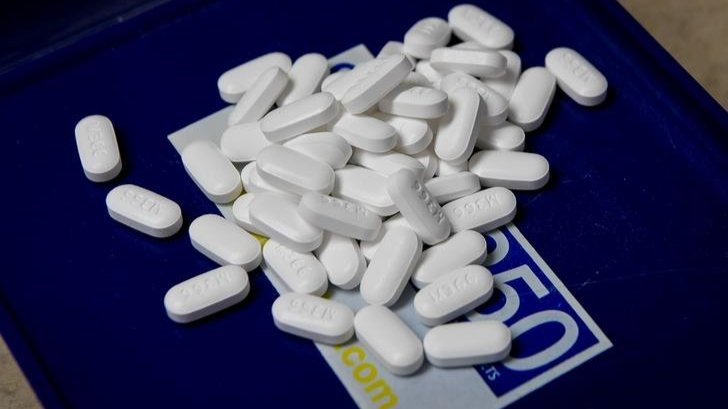
Is last week's $26 billion national opioid settlement with the nation's largest drug distributors and Johnson & Johnson good enough?
That's a question treatment advocates and some lawyers are asking after the announcement of a deal resolving thousands of lawsuits by state and local governments that accused McKesson, AmerisourceBergen, Cardinal Health and J&J of fueling the epidemic.
Tom Hals reports that treatment advocates are concerned about the slow pace over 18 years that the money will be provided and worry it could be misspent on causes unrelated to addressing the addiction epidemic. The deal will also need near universal agreement from states and local governments to get the maximum payout.
"As someone on the ground, $26 billion makes a flashy headline," said Ryan Hampton, who is in recovery from addiction and has worked with non-profits and lawmakers on the opioid crisis. "But spread over 18 years, it’s pennies."
For another view of why the deal doesn't pay out enough, head to West Virginia. There, Brendan Pierson reports, lawyers for the city of Huntington and Cabell County on Tuesday delivered closing arguments in a closely-watched trial in their bid to obtain $2.5 billion from the distributors.
Paul Farrell, a lawyer for the county at Farrell Law, said a region with less than 100,000 people was flooded with more than 81 million pills, demonstrating the companies' "failure to maintain effective control to prevent diversion." His client and other West Virginia localities opted against joining the settlement, saying it paid too little for the hard-hit state. See how the companies are fighting his case.
Industry buzz
- Some large law firms are beginning to augment their office returns plans in response to the rise of the Delta variant and the slowdown in COVID-19 vaccinations nationally. Paul Weiss chair Brad Karp in a memo last week told employees that unvaccinated personnel will be denied access to its offices. (The American Lawyer)
- President Joe Biden has nominated Cohen, Weiss and Simon partner Lisa Gomez to be assistant secretary for the Employee Benefits Security Administration at the U.S. Department of Labor. In the position, Gomez would oversee private retirement plans and other worker benefits. (Reuters)
- Want another sign of how a surge in deal work and higher-than-usual attrition rates among Big Law associates is pushing up demand by law firms to hire junior lawyers? The Financial Times reports that Paul Hastings and Goodwin Procter are offering bonuses of $50,000 and $30,000, respectively, to lawyers who recommend new associates. (FT)
- Less than two months after launching, Dentons Global Advisors is acquiring a European public affairs consulting company. Dentons' consulting company, which was formed after the firm snagged former U.S. Secretary of State Madeleine Albright's consulting business, will pick up Interel in a deal expected to close Friday. (Reuters)
- A Chicago attorney is suing his former employer, Kutak Rock, accusing the firm of botching his chance at a lucrative Illinois cannabis license by adding some of its other clients to his application. Lance Tyson, who is represented by Gary Grasso, says he trusted the firm but has lost his chance at entering the pot industry. (Reuters)
- McDermott Will & Emery is asking a D.C. judge to allow the firm to scrutinize rival Wiley Rein's business practices after Wiley Rein admitted to violating ethics rules by representing both parties in an employment lawsuit. The request is part of a lawsuit McDermott filed on behalf of client, accounting firm BDO USA, against one of its former employees, who is represented by Wiley Rein. (Reuters)
Source: Reuters, Supreme Court
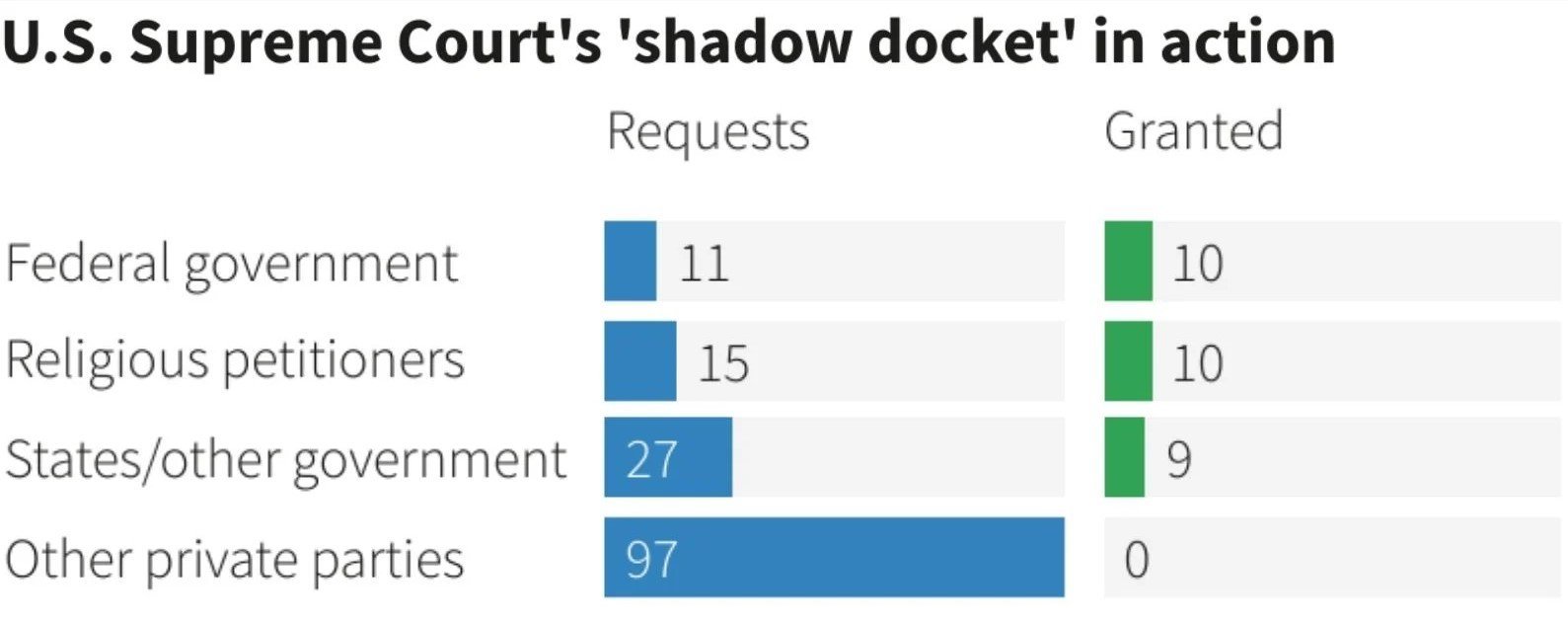
That's the number of requests for substantive relief that the U.S. Supreme Court has granted in whole or part in response to 150 emergency applications over the last 12 months on the justices’ so-called "shadow docket." An analysis by Lawrence Hurley and Andrew Chung found that the conservative-majority court repeatedly favored not just religious groups, who frequently challenged coronavirus gathering restrictions, but also the Trump administration. David Gans, civil rights director at the liberal Constitutional Accountability Center, said the data indicates the court has a "serious legitimacy problem" because of the lack of transparency and the impression that certain litigants have favored status. (Reuters)
Join us!
Reuters' Alex Cohen is hosting a 30-minute chat today on legal work on environmental, social and governance issues and sustainability as a follow up to the Reuters Legal story on how top law firms advise clients on ESG.
Join Alex and ESG experts Professor John Dernbach of the Widener University Commonwealth Law School, Professor Matt Bogoshian of University of California, Davis School of Law and Scott Janoe of Baker Botts on Twitter Spaces at 2pm ET/11am PT.
Here's the link to hear the conversation. You can tweet your comments and questions using the hashtag #askreuters.
Coming up today
- The U.S. House of Representatives' Judiciary Subcommittee on Antitrust, Commercial and Administrative Law will hold the first of a series of hearings on potential bankruptcy law reforms. Among the issues the panel will examine is the use of non-consensual releases for non-bankrupt parties, a tactic that critics say could allow members of the wealthy Sackler family who own Purdue Pharma to use the OxyContin maker’s Chapter 11 bankruptcy case to avoid future lawsuits against them over their roles in the opioid epidemic. The Sacklers have agreed to contribute a combined $4.5 billion toward Purdue's bankruptcy-exit plan to resolve the claims against them.
- FTC Chair Lina Khan will appear with other commissioners before the U.S. House Energy and Commerce Committee's Consumer Protection and Commerce Subcommittee for a hearing on proposals to modernize the agency’s consumer protection program.
- The U.S. Senate Judiciary Committee will hold a hearing on five of President Joe Biden's judicial nominees, including Virginia state solicitor general Toby Heytens for a seat on the Richmond, Virginia-based 4th Circuit. Heytens is a former clerk to the late U.S. Supreme Court Justice Ruth Bader Ginsburg, and he argued recently in support of an order from the Virginia governor to remove a Confederate statue of General Robert E. Lee.
- The Native American community of Nuiqsut, in northern Alaska, and environmental groups will urge the 9th Circuit to reverse a lower-court ruling in favor of the Bureau of Land Management in their challenge to the agency's approval during the Trump era of ConocoPhillips' plan for winter oil and gas exploration activities in the National Petroleum Reserve-Alaska. Jeremy Lieb of Earthjustice will argue for the plaintiffs and will face Amelia Yowell of the DOJ for the government and Jason Morgan of Stoel Rives for ConocoPhillips.
- Board members, executives and a former majority shareholder of COVID-19 vaccine maker Vaxart Inc will ask Delaware Vice Chancellor Paul Fioravanti to dismiss a stockholder lawsuit filed derivatively on the company's behalf over hedge fund Armistice Capital's sale of certain of its shares. Shareholders represented by lawyers at Bernstein Litowitz, Pomerantz and Quinn Emanuel accuse them of completing the transaction at an "inflated" price and based on non-public information at the company's expense. The defendants, represented by Riccardo DeBari of Thompson Hine and Douglas Rappaport of Akin Gump, deny the allegations.
- The Boston-based 1st Circuit will consider reviving a proposed class action claiming 7-Eleven franchisees were actually the convenience store operator's employees. Plaintiffs' lawyer Shannon Liss-Riordan of Lichten & Liss-Riordan will argue that a federal judge was wrong to conclude that Massachusetts' strict test for worker classification was preempted by its franchise law, which allows franchisors to exert control over certain aspects of franchise businesses in order to maintain brand quality and uniformity. Norman Leon of DLA Piper will argue for 7-Eleven.
Bryan Cave partner on how anti-doping efforts combine science, law and politics
While the news is consumed with the athleticism on display at the summer Olympics in Tokyo, the weeks leading up to the Games were filled with stories about athletes that aren’t competing after running afoul of anti-doping rules. Sprinter Sha'Carri Richardson was suspended despite qualifying because she tested positive for marijuana in a state where it is legal, while middle-distance runner Shelby Houlihan was suspended before the start of the trials because she tested positive for a steroid she says came from a pork burrito.
|
|
Richard Young
Bryan Cave
|
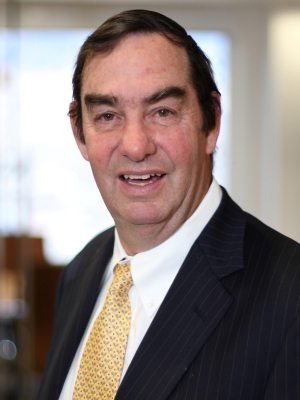
Bryan Cave Leighton Paisner partner Richard Young has represented both athletes and the World Anti-Doping Agency, or WADA, and is credited as the lead drafter of the World Anti-Doping Code. The Daily Docket caught up with him to talk about how the rules have changed over the years.
On how he got into writing doping rules: "In the mid-90s, [I handled] a case for USA Shooting where an athlete had been competing in Cairo, and he got deathly sick that night. The doctor prescribed medication. He survived and medaled, and then he tested positive [for a banned substance] and they took away his medal. We appealed that decision … and we won the case. The International Olympic Committee thought they had a strict liability rule, which turned out to not be the case."
On how the rules have changed to address situations when athletes ingest something accidentally: "The initial code [in 2003] wasn't very flexible because we were afraid people were going to go back to doing what they wanted to do. [The standard in] 2003 was strict liability. Now, there's very different treatment for substances of abuse, there’s an opportunity if you can show no significant fault to significantly reduce sanctions in contamination cases. Now, every time we modify the code we’ve added more flexibility to it."
On how anti-doping authorities view marijuana legalization and whether it should impact anti-doping rules: "As a general proposition, I don't think there would be any sport where being really stoned would help you. On the other hand, anxiety is a negative performance enhancer. Then there’s simply the politics. Even if the federal government would [legalize], that would be an outlier with the rest of the world. A lot of governments would still say you would violate the spirit of the sport [by using it.]"
"It's almost unfathomable to me. I'm not sure if I saw it on television I would find it believable."
U.S. District Judge Allison Burroughs, who during a hearing in Boston sentenced former eBay security official Philip Cooke to 18 months in prison followed by a year of home detention for his role in a cyberstalking campaign that targeted a Massachusetts couple whose online newsletter was viewed as critical of the e-commerce company. Prosecutors said that campaign included harassing them online, surveilling them and sending the couple disturbing packages, including live cockroaches and a bloody Halloween pig mask. (Reuters)
In the courts
- Bankrupt gunmaker Remington has offered to pay nine families of victims killed in the 2012 Sandy Hook Connecticut school massacre a total of $33 million to settle their claims. The offer from the company, which is represented by Day Pitney and Swanson Martin & Bell, is a far cry from the families’ total claims against the company, which could hit $1 billion with punitive damages. Josh Koskoff of Koskoff Koskoff & Bieder, one of the attorneys for the families, said they would "consider their next steps." (Reuters)
- The U.S. government officially sold Martin Shkreli's copy of Wu-Tang Clan's album "Once Upon a Time in Shaolin," which the convicted pharma fraudster handed over to help pay $7.4 million in restitution. The feds are keeping the buyer and price confidential, but said the sale of the album -- the only copy in existence -- would satisfy the remainder of Shkreli's restitution. (Reuters)
- Puerto Rico's federally-appointed financial oversight board has finalized a deal with two key creditors, the bond insurers Ambac and FGIC, adding to growing support for the proposed plan to fix the territory’s debt crisis. The deal that the board’s lawyers led by Martin Bienenstock of Proskauer Rose helped cut resolves the insurers claims to certain revenues and sets aside $260 million for holders of debt issued by the Puerto Rico Infrastructure Financing Authority. (Reuters)
- Jurors in King County Superior Court in Seattle, Washington, determined that Bayer-owned Monsanto should have to pay $185 million to three former teachers who alleged they suffered brain injuries as a result of exposure to polychlorinated biphenyls, or PCBs, in a school building. The company, which was represented by Adam Miller of Shook Hardy & Bacon, said the evidence did not support the verdict and that it would challenge the award in post-trial motions and on appeal. The plaintiffs are being represented by Rick Friedman of Friedman Rubin. (Reuters, Courtroom View Network)
- Retail investors suing Robinhood and others like Citadel Securities over trading restrictions in the wake of a social media-fueled rally that squeezed short sellers filed consolidated class-action complaints seeking potentially billions in damages in federal court in Miami. The complaints, which came ahead of Robinhood's closely-watched IPO, consolidate claims from dozens of lawsuits. Kevin Orsini of Cravath is leading Robinhood's defense. (Reuters)
- Rivals Bio-Rad Laboratories and 10x Genomics have settled their multi-front battle over microfluidic genetic analysis technology with an agreement to cross-license their single-cell analysis patents. Their patent litigation included more than 20 different disputes in federal courts, German tribunals, the PTAB and the U.S. International Trade Commission. "We always had conviction that we were on the right path and that has been underscored today," 10x general counsel Eric Whitaker said. (Reuters)
- A former intelligence analyst was sentenced by U.S. District Judge Liam O'Grady in Alexandria, Virginia, to 45 months in prison after admitting he illegally obtained and disclosed classified national defense information about a U.S. drone strike program to a journalist. While the indictment does not name the publication or journalist that Daniel Hale leaked the information to the description matches that of Jeremy Scahill of the Intercept, which in 2015 published a series called "The Drone Papers." (Politico)
- Former hedge fund titan Michael Steinhardt has lost a lawsuit he filed against the Manhattan-based Hirschl & Adler Galleries and its president over allegations they made an "unfair secret profit" from the $12 million sale on consignment of a portrait of George Washington. Manhattan Supreme Court Justice Joel Cohen rejected the arguments by Steinhart's lawyers led by David Shapiro of Shapiro Litigation Group on how to interpret his contract with the gallery. (Reuters)
Industry moves
- Wendy Klein Keane, who serves as litigation and risk management counsel for homebuilder Toll Brothers, has joined Cozen O’Connor as a member of its construction law group in Philadelphia. (Cozen)
- Cybersecurity and privacy lawyer David Kitchen has joined Norton Rose Fulbright as a partner in Denver. He was previously at Baker Hostetler. (Norton Rose)
- Intellectual property attorney Pejman Sharifi has joined Fox Rothschild as a partner in New York. He arrived from Winston & Strawn. (Fox Rothschild)
Columnist spotlight: State Street fallout for Labaton: Texas lawyer sues over unpaid 'referral' fees
A Texas lawyer named Damon Chargois has already reaped millions of dollars for helping plaintiffs' firm Labaton Sucharow establish a client relationship with an Arkansas pension fund. That fee-sharing deal brought Labaton considerable grief in the notorious State Street fee investigation, in which a federal judge in Boston slashed Labaton's fee award by $10 million – and said the Chargois deal was a breach of Massachusetts' rules of professional conduct. But Chargois says Labaton still owes him money. Alison Frankel has the goods on Chargois' new declaratory judgment lawsuit against Labaton. Read here to find out more about the case against Labaton.
Lawyer speak: Renewed focus on personal jurisdiction can level litigation playing field
The U.S. Supreme Court's ruling in March in Ford Motor Company v. Montana Eighth Judicial District Court has brought renewed attention to the issue of personal jurisdiction in product liability and mass tort cases. Philip Federico of Schochor, Federico and Staton and Chase Brockstedt of Mandalas Brockstedt write that before the decision, “the playing field was seen as tilted toward defendants, with recent decisions restricting jurisdiction over out-of-state defendants.” But they say that the top court’s decision provided new certainty that would allow plaintiffs to fight defense efforts to restrict where they can be sued. Read more.
Copyright © 2021 Thomson Reuters. All rights reserved. 610 Opperman Drive, Eagan, MN 55123
Want to change how you receive these emails?
You can unsubscribe from this list here.
|